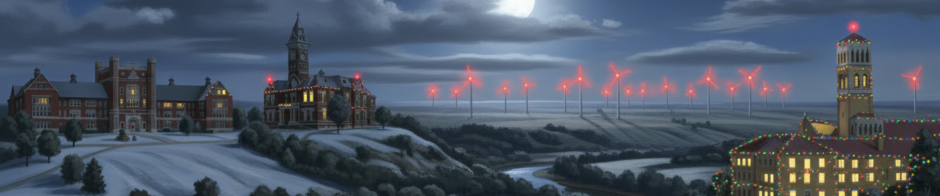


The founding of the Conception is quite an amazing story. To begin with, Conception is not based on the virgin birth as many people believe, but rather on the Catholic teaching that Mary was immaculately conceived in the womb and thus without sin. This teaching was promoted in 1854. In 1855, William Brady led a group of Irish immigrants from Reading, Pennsylvania, to Nodaway County in search of cheap land. Brady and his family walked more than 40 miles from St. Joseph to the Conception area in an era when there were no roads. They named the community for the Papal rule that had just been instituted in 1854.
The photo is from the August 2, 1975 issue of the Forum. The caption says A family portrait taken Aug. 16, 1891, shows Irishman Johnnie; son-in-law Robert Graham; grandchildren William Brady and his wife, Rose, in the center; and Lily and Mamie Keeler; daughter Alicia Brady in the foreground. Brady was an organizer and legal representative of the Irish settlers, who founded the Ann Catholic colony at Conception. Brady’s sons were Tomas and Sarsfield; son was James P.; grandchildren were Josephine and others. From left to right: Son, Alicia Keeler, and daughter, Elizabethe Brady Meyer.
The Maryville Daily Forum 1975 Aug 02 Page 1 Page 2 Brady Leads Conception Settlers by Teresa Carpenter, University of Missouri Extension Office
In the wake of the great Irish potato famine of 1845-46, William Brady of Oldcastle, County Meath, joined the exodus from his native Ireland to North America. Brady, a 31-year-old bachelor, disembarked in New York City, where, despite a good education, he encountered the anti-Irish sentiment that most of his countrymen faced. He took a series of odd jobs to make ends meet and married Rose, the daughter of a fellow emigrant, Patrick Growney. Promised a job as paymaster for a construction firm, Brady took his bride to Reading, Pa., but found unrest brewing there. The Great Economic Depression of 1855 left Irish workers jobless.
In cooperation with Catholic construction executives, Father James Power, pastor of St. Peter’s Parish in Reading, encouraged the unemployed to resettle in the Midwest, where the government offered land for colonization. The Reading Land Association was formed to obtain land for the colony. It met resistance, however, from pro-slavery factions in Missouri who feared an influx of northern Irish with no money nor inclination for slave-owning.
Colony representatives overcame legal barriers thrown up by the resistance and purchased 20,000 acres of land in Jefferson Township, Nodaway County, for $1.00. William Brady, a chief organizer, was made legal representative with the authority to deed land to his associates. There is no record of how many of the 58 land subscribers left Reading in the spring of 1858, but the group arrived in St. Joseph by riverboat during the first half of April that year. Terrified by tales of scalps, rattlesnakes, and prairie wolves in Nodaway County, most of the group remained in St. Joseph. Only a cluster of colonists led by Brady left for Nodaway County at 10 a.m., Friday morning, April 16, 1858, with five wagons drawn by oxen. Since measles had broken out among the children, the adults all walked to avoid contagion. On the third day, a leaky boat carrying women and children nearly capsized on the Platte River. On April 20, 1858, travelers arrived at the location of present-day Conception.
They were lodged in the cabin of Silas Best, the only settler in the area, while Brady set off for Maryville, the county seat, to find the exact location of each member’s parcel. When the sizes of the farms were established, Brady and two other colonists built a sod shanty 12 x 15 feet. Three other cabins were erected, and the farm work began. It was a wet year, and plowing was difficult. None of the men had any experience handling oxen, and for nearly four years the colonists shared one horse, “Charley.” The men were further distressed to find rattlesnakes coiled within their boots in the morning.
Discouraged, the settlers complained to visiting Father Powers that they faced hardships without any formal consolations of faith. The priest performed the first Mass in the colony at William Brady’s shanty on 1 Oct. 25, 1858. At that time, he also baptized the colony’s first two children. In the spring of 1860, Brady and Father Power laid out the present town of Conception, named to honor the doctrine of the Immaculate Conception, then proclaimed by Pope Pius IX.
In Europe, the abbot of Engelberg, envisioning Conception as an eventual refuge from persecution in Switzerland, sent two Benedictines to found a religious house. The need for a “New Engelberg” never materialized, but a monastery was established in 1873 and elevated to abbey status in 1881. During the growing years of Conception, William Brady wore the cap of colonist, surveyor, and judge. The Bradys, whose ten children were all born in the colony, eventually moved from their sod house to a two-story frame home with elaborate “gingerbread” embellishing the front portico – all executed by the skillful hand of William Brady.
A “deeply religious man,” according to his granddaughter, Miss Ann Brady, William, nonetheless, retained a puckish humor. The story is told of the Reverend Placidus Schmid, pastor of the Immaculate Conception Parish for over 40 years. Father Placidus was jumping his pony over a ditch near Judge Brady’s house when the saddle broke, tossing him into the creek. Unhurt, he stopped by Brady’s home for a drink of water. Brady admonished that water was not good for health in hot weather and offered him lemonade instead. On the return trip, Father Placidus became so dizzy that he could not ride, so he dismounted and walked five miles to Conception. He later discovered that he had refreshed himself with Judge Brady’s brandy.
Brady divided his land among four sons: Sarsfield, Johnnie, Lawrence, and William E. A fifth son, James P. Brady, received an education instead. Named for Father James Power, young Brady was the first parishioner of the Conception Parish to be ordained a Catholic priest. William Brady, senior, died around the turn of the century.
Ann Brady remembers her grandfather as an elderly man sitting at his desk, wearing a black cap to keep the back of his head warm. “He sat in his big chair and read and wrote,” she recalls. “They didn’t call that retirement in those days.” Today, Ann Brady, 80, her brothers Martin, 72, and Paul, 68, own 203 acres inherited from their father, William E. Brady. The parcel has been designated a centennial farm by the Nodaway County Agricultural Emphasis Bicentennial Committee.
Ann went to school at the convent and later took nurses training in St. Joseph. Martin and Paul have been farming the land since they were children. The brothers and sisters, all unmarried, are the only remaining descendants of William Brady senior in Nodaway County. The others have left.
“There are only three of us left,” says Ann. “Not a cousin nor a grandchild. None left but us. The farm will be in the family as long as we last.”
Immaculate Conception Is Not About Virgin Mary Birth
Following information is an AI interpretation of the concept.
The Immaculate Conception is a Roman Catholic dogma stating that Mary, the mother of Jesus, was preserved from all stain of original sin from the moment of her conception in her mother’s womb. Defined by Pope Pius IX in 1854, this dogma teaches that Mary was filled with grace and remained sinless throughout her life, by a singular, preemptive grace from God in view of her son’s merits.
Key Aspects of the Doctrine
- Definition: It declares that Mary, by a special grace from God, was kept free from the “original sin” inherited by all human beings, from the very first moment of her existence.
- Not the Virgin Birth: The Immaculate Conception refers to Mary’s conception by her mother (traditionally known as Saint Anne) and is distinct from the Virgin Birth of Jesus.
- “In View of the Merits of Jesus”: Catholic theology clarifies that Mary was saved by Jesus, but in a more sublime manner—prevented from falling into sin rather than being redeemed from it afterward.
- Definition as Dogma: Pope Pius IX officially defined this dogma in the 1854 papal bull Ineffabilis Deus.
- Feast Day: The Feast of the Immaculate Conception is celebrated on December 8, a Holy Day of Obligation in many places, including the United States.
- Purpose: The doctrine emphasizes that Mary was prepared to be the immaculate, perfect vessel for the incarnation of Jesus Christ.
While widely accepted in Catholicism, this doctrine is not accepted by most Protestants, and it is not explicitly defined in the Bible, though some Catholics interpret Genesis 3:15 as a foreshadowing of this belief.