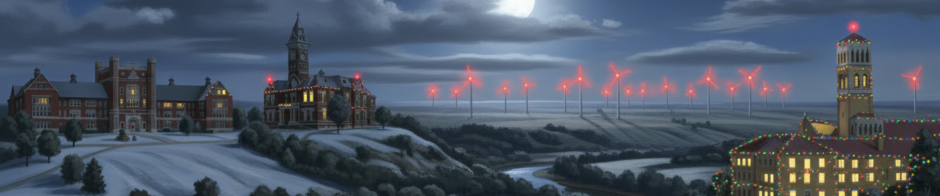
The four-sided clock tower of the historic 1883 Nodaway County Courthouse in Maryville, Missouri, rises 114 feet above the town square and features a timekeeping mechanism originally built to be wound by hand every day. [1, 2]
Design and Construction
- Architects: Designed by the firm Eckel & Mann (Edmund J. Eckel and George R. Mann) of St. Joseph, Missouri.
- Style: High Victorian Italianate / Italianate features built with red St. Joseph brick and Parkville sandstone.
- Tower Height: Rises to a four-story height of 114 feet asymmetrically above the main entrance arch, visible across Maryville. [1, 2, 3, 4]
Clock Operation and Evolution
- Manual Winding: When first installed, the tower clock’s heavy internal weights required daily manual winding to keep the clock faces accurate. [1]
- Electrification: In the 1940s, an electric motor was added to the clockworks to automate the winding process and eliminate the daily manual labor. [1]
- Preservation: Despite proposals in the 1970s to tear down the aging courthouse, the building—including its signature clock tower—was preserved, listed on the National Register of Historic Places on October 11, 1979, and continues to serve as the functional heart of the Nodaway County Courthouse complex. [1]
The above was AI generated.
Here is 1975 article about Gordon Bennett work on the clock as working on the clock
2010 Replacement of Cupola
The cupola of the historic Nodaway County Courthouse in Maryville, Missouri, was officially replaced in late 2010. [1]
This replacement was a major milestone for the Nodaway County Courthouse, which was built between 1881 and 1883 and is listed on the National Register of Historic Places. [1, 2]
Key Details of the 2010 Project
- Scope of Work: In addition to fabricating and replacing the entire rooftop cupola structure, the project included extensive repairs to the building’s exterior masonry, brickwork, and ornamental metalwork. [1]
- Historical Significance: Prior to the 2010 renovation, the building had seen very few major structural alterations since its completion in 1883, aside from a courtroom floor replacement in 1932 and minor exterior work in 1950. [1]
2011 Storm Destroys Roof and Clock Tower
Severe weather impacted Maryville, Missouri, and Nodaway County on August 18–19, 2011, bringing destructive straight-line winds and large hail. [1, 2, 3]
Event Details
- Date: August 18–19, 2011 [1, 2]
- Wind Speeds: 70 to 100 mph damaging straight-line winds [1, 2]
- Hail Size: Ranged from quarter-sized (1.00″) up to golf ball-sized (1.75″) and larger in surrounding areas [1, 2]
- Impacts in Maryville:
The Nodaway County Courthouse in Maryville, Missouri, sustained significant damage during a severe hail and wind storm in August 2011, which destroyed parts of the roof and the clock tower cupola. [1]
- Roof Damage: High winds and large hail severely damaged the steeply hipped slate roof, leading the County Commission to budget nearly $189,000 for full roof replacement using synthetic slate shingles. [1]
- Clock Tower: The original wood-and-metal clock tower cupola succumbed to weather and storm exposure, requiring a full replica replacement covered largely by insurance. [1]
Straight-line winds form through intense thunderstorm downdrafts, and when combined with large hail, they create a “machine gun fire” damage pattern by firing hard ice horizontally at high velocities. [1, 2]
Here is a breakdown of how this intense meteorological phenomenon happens.
1. How Straight-Line Winds Form
Straight-line winds are powerful, non-rotating winds generated by a severe thunderstorm’s downward motion. They are most commonly produced by a process called a downburst (or smaller microbursts): [1, 2, 3, 4]
- Evaporative Cooling: Inside a mature thunderstorm, rain and hail fall through a layer of dry air aloft. The liquid water evaporates rapidly into the dry air. [1, 2, 3, 4]
- The Sinking Column: Evaporation absorbs heat, rapidly cooling the air. This chilled air becomes significantly denser and heavier than the surrounding warm atmosphere. [1, 2, 3]
- The Impact and Outflow: Gravity pulls this massive pocket of heavy, cold air downward. It accelerates as a violent “downdraft”. When it slams into the Earth’s surface, it has nowhere else to go, so it compresses and bursts outward horizontally. [1, 2, 3, 4, 5, 6]
- Straight-Line Destruction: This outward rushing air can easily exceed 80 to 100+ mph. Because the wind blows in a singular, uniform direction outward from the center of the downburst, the debris it leaves behind falls parallel in a straight line—unlike the chaotic, swirling debris fields of a tornado. [1, 2, 3, 4, 5, 6]
2. The “Machine Gun Fire” Effect
Normally, hail falls downward due to gravity. However, when a severe downburst occurs simultaneously with a heavy hail core, the physics of the storm damage change entirely: [1, 2, 3]
- Horizontal Bullet Trajectories: The hurricane-force horizontal straight-line winds hijack the falling hailstones. Instead of falling vertically, the stones are caught in the lateral airflow and fired sideways at speeds up to 100+ mph. [1, 2]
- Rapid-Fire Volleys: Thunderstorms pack millions of hailstones into dense pockets. When weaponized by the wind, these thousands of ice projectiles strike a stationary object in rapid, continuous succession over the course of just a few minutes.
- The Visual Result: When wind-driven hail blasts the side of a house or vehicle, it leaves behind a distinct pattern that perfectly mimics ballistic damage:
- Siding (especially vinyl or wood) is completely riddled with small, jagged, closely grouped holes.
- The damage is strictly localized to one side of the structure (the side facing the oncoming wind), leaving the other sides entirely untouched.
- Vehicles parked in the path end up with shattered side windows and doors pockmarked by deep, round dents that look exactly like shrapnel impacts or a strafing run from automatic weapons. [1, 2]
Jokes About Replacing the Nodaway Courthouse Tower Twice in 2 Years
- Nodaway County’s courthouse cupola and clock have had a busy couple of years: first they retired from old age, then hail and straight-line winds called them back for one more round.
- The courthouse clock has been replaced twice in two years. At this rate, it’s less a timepiece and more a frequent flyer.
- First the cupola and clock said, “We’ve served our time.” Then the hailstorm said, “Not so fast.”
- Nodaway County’s courthouse got a new cupola and clock because the old ones were worn out. Then Mother Nature took a look and said, “Let’s try that again.”
- The clock’s had two replacements in two years—but at least it’s finally keeping up with the weather.
- Nodaway County’s courthouse has a new cupola and clock again. You could say the old ones were retired twice: once by age, and once by a very convincing hailstorm.
- The courthouse clock must be wondering what time it is: “Am I on the old schedule, or the new replacement schedule?”