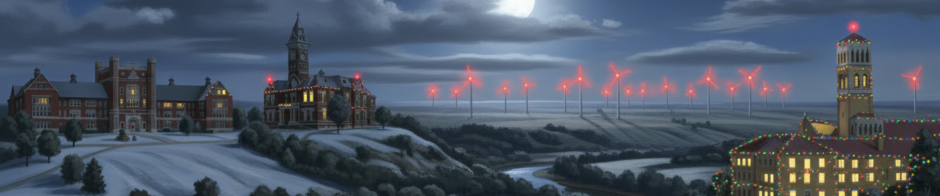
The First United Methodist Church in Maryville, Missouri, traces its roots to circuit-rider services in the 1840s and stands as the city’s oldest Protestant congregation and is oldest church building in Maryville. [1, 2]
History
- Early Beginnings: Methodism arrived in Nodaway County in the 1840s with small-group services held in private homes before the Maryville Circuit was established in the 1850s. [1]
- First Buildings: The first Methodist Episcopal Church building in Maryville was erected in 1866 at the southeast corner of First and Main, marking the first Protestant church building in the town. [1, 2]
- Civil War Divisions: Like much of Missouri, the community and its churches were deeply split over slavery. A separate branch—the Methodist Episcopal Church, South—was organized in 1846 and later built a church at West Second and Buchanan. [1, 2]
- Present Sanctuary: The current congregation built its permanent home at the northwest corner of First and Main in 1894 (with the historic sanctuary completed around 1897). [1, 2]
- Reunion: Following the 1939 national reunification of the Methodist Episcopal Church and the Methodist Episcopal Church, South, the Maryville congregations merged. The Buchanan Street property was sold to clear debts, and the Main Street location became the unified church. [1, 2]
Notable Things & History
- Landmark Seminary Connection: The land that later became Northwest Missouri State University included property and grounds originally tied to the Maryville (Methodist) Seminary, founded in 1889. [1]
- Drive-In Church Innovation: During the hot summer of 1952, pastor Bishop Alonzo Monk Bryan combated low attendance before air conditioning by moving services outdoors to the local Dude Ranch Drive-In. He preached from the roof of the concession stand while the message played through car speakers. [1]
- Historic African American Methodist Roots: The region’s Methodist history also parallelled the founding of the local African Methodist Episcopal (A.M.E.) Church in 1879 by twelve Black community members, which later operated as Ward’s Chapel and Bethel Chapel. [1]
- Modern Community Outreach: Located at 102 N. Main St., the First United Methodist Church of Maryville continues active local programs, including hosting community support groups like the Maryville Memory Cafe in partnership with regional health organizations.
The historic 1897 sanctuary of the First United Methodist Church of Maryville stands as a classic regional adaptation of Late Victorian Romanesque and Gothic Revival church styling. [1, 2]
Exterior Architecture & Design
- The Masonry Work: The building features a robust, load-bearing red brick facade laid out in a massive, grounded footprint typical of late 19th-century Midwestern town churches.
- The Asymmetrical Towers: The exterior profile is heavily anchored by an dominant corner entry and bell tower. The primary square bell tower steps up into prominent louvered belfry openings, creating a sharp, recognizable silhouette in downtown Maryville. [1]
- Window Styling: The structure showcases dramatic heavy masonry arches framing large, multi-tiered stained-glass windows. These round and pointed arches draw structurally from both Romanesque and Gothic traditions. [1]
Interior Layout & Modern Preservation
- The Congregation Floor: True to Methodist traditions of the era, the historic main sanctuary space features an integrated layout optimized for acoustics and visibility, framing an intimate yet expansive worship space. [1, 2]
- Preservation Efforts: While the church has seen extensive interior support updates to meet accessibility demands over the generations, the original 1897 timber framing, structural curves, and sacred worship perimeter have been strictly kept intact. [1]
- Modern Integration: Rather than replacing the historic layout, modern renovations handled by regional designers like Mantel Teter Architecture wrapped a new glass-and-brick gathering foyer, elevator tower, and modernized entry right alongside the 1897 brick canvas. This allows the original historic sanctuary shell to remain entirely active for services today.
Artistic Style and Visual Impact
- Late Victorian Art Glass: The windows feature opalescent and cathedral art glass, which was highly popularized during the late 19th century by American artisans. Unlike standard European painted glass, this style incorporates rich textures, milky opacity, and swirling tones directly into the glass mix. [1, 2]
- The Interplay of Light: Positioned within the massive masonry arches of the 1897 structure, these multi-tiered window groupings filter harsh natural light into a soft, multicolored glow across the sanctuary floor. [1]
- Religious Imagery: True to the style of the era, the primary window configurations integrate geometric Christian motifs, floral design work, and dedicated focal panels featuring sacred biblical scenes and symbols. [1]
Historical Significance and Preservation
- Community Legacies: In keeping with standard 19th-century church building traditions, many of the smaller lancet and lower perimeter window panels were funded or dedicated by foundational Nodaway County families, acting as visual memorials. [1]
- The 1980s Interior Reorientation: During a major building remodeling effort in the 1980s, the church reoriented its interior seating layout to face a different direction. This shift significantly altered how the congregation interacted with the space, bringing the primary stained-glass window configurations directly into the assembly’s main viewing focus during weekly services. [1]
- Recent Facelift and Restoration: Over the decades, old protective coverings and natural aging have caused the lead and glass matrices to haze. Specialized artisans executed a detailed historical restoration and facelift of the window assemblies. This process cleared away decades of surface fogging, stabilized the structural lead cames, and successfully restored the vibrant saturation of the original 1890s colors. [1]
The First United Methodist Church of Maryville in Maryville, Missouri, was not affected by the disaffiliation split; it remains an active congregation within the Missouri Annual Conference of the United Methodist Church. [1, 2]
- Status: The church continues its regular worship services, community programs, and local outreach. [1, 2]
- Denomination: It remains affiliated with the United Methodist Church rather than splitting or joining a breakaway group like the Global Methodist Church in 2019.